Service Guide
Pool Deck Restoration on Cape Cod: What Salt Air Does to a Deck
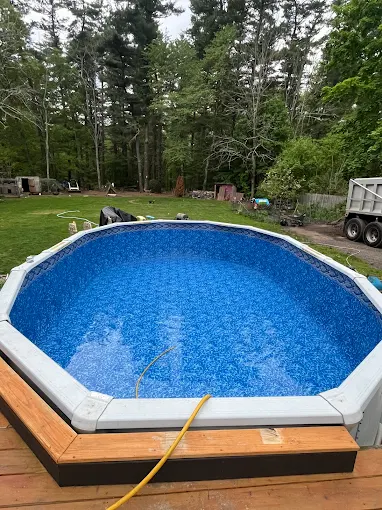
Pool deck restoration on Cape Cod is a different job than it is thirty miles inland. Salt air, blowing sand, and fast-draining sandy soil age a deck from three directions at once, and a deck that would still look fine in Worcester County can look ten years older in Barnstable County.
What coastal air actually does to a pool deck
Salt-laden air corrodes fasteners and hardware first, long before the boards give up. Screws rust from the inside, joist hangers stain, and the connections that hold the deck square start to loosen.
Sand is the second problem. Wind-driven sand acts like light sandpaper on the finish, so stain and sealer wear off faster on the exposed side of the deck than the sheltered side.
Then there is moisture. Fog and humidity keep boards damp longer near the water, which feeds mildew and softens end grain where boards were cut on site and never sealed.
- Rust streaks bleeding out of screw heads
- Boards that feel spongy at the ends but solid in the middle
- Railing posts that wiggle when you lean on them
- Green or black film that comes back within weeks of a wash
- Nail pops and raised screws that catch bare feet
Restore or replace: how we decide
The frame decides. If the joists, beams, posts, and footings are sound, the deck is a restoration candidate no matter how bad the surface looks. If the structure is rotted or undersized, new boards on top are money thrown away.
We check the frame from underneath with a probe, look at every post base, and put weight on the stairs and rails. Surface problems are cheap. Structure problems are not.
| What we find | Typical path | What the work involves |
|---|---|---|
| Sound frame, tired boards | Restore | Wash, replace bad boards, reset fasteners, sand, seal |
| Sound frame, failed railings | Partial rebuild | New rail system and stair treads, keep the structure |
| Soft joists or rotted post bases | Rebuild | New framing and footings, then a new surface |
| Concrete deck with cracks and spalling | Resurface | Crack repair, patching, and a new wearing surface |
| Deck built too low or badly sloped | Redesign | Reframe with proper height, slope, and drainage |
What a coastal restoration includes
A real restoration is more than a pressure wash and a coat of stain. Washing hides the problems for one season and then they come right back.
- Full structural inspection, including under the deck and at every footing
- Replacing failed boards and any framing that probes soft
- Swapping corroded fasteners and hardware for coastal-rated stainless or coated equivalents
- Cleaning and brightening the wood so the new finish bonds instead of sitting on grime
- Sanding down raised grain and rough edges where people walk barefoot
- Sealing all cut ends, which is where coastal rot almost always starts
- Resetting or rebuilding rails and stairs to feel solid, not just look solid
Materials that hold up near the water
Pressure-treated framing is still the workhorse under a coastal deck, but the hardware matters more than the lumber. Cheap fasteners in salt air are the fastest way to a loose deck.
For the walking surface, composite holds color and shrugs off sand and salt better than wood, at a higher upfront cost. Wood costs less to install and looks great, but on the Cape it wants a real maintenance schedule, not a good intention.
Sandy soil, footings, and why decks near the coast move
Cape Cod soil drains fast, which is great for puddles and rough on footings. Loose sand does not hold a post the way dense inland soil does, and water running off a deck can wash out the ground around a footing over a few seasons.
That is why a deck can be square in year one and racked in year six with no visible rot anywhere. The frame did not fail, the ground under it moved.
When we see that, we fix the water before we fix the wood. Our storm water management and grading work redirects runoff away from posts, and the full breakdown lives in our guide to backyard drainage around a pool.
Timing a Cape project
Spring and fall are the good windows. Summer on the Cape means traffic, rentals, and a yard full of people, and finishes need dry days with moderate temperatures to cure right.
Fall has one more advantage. Once pools close, we can work the deck without scheduling around swimming, and the deck is ready the day you open next season.
We travel the Cape and the islands regularly, and you can see the full list on our Barnstable County service area page. If your surface is past saving, our pool deck restoration and deck building crews are the same people, so you get one quote either way.
Not sure whether you want a deck at all? Our post comparing an above-ground pool with a deck versus no deck lays out both sides honestly.
Frequently asked questions
How often should a Cape Cod pool deck be resealed?
More often than an inland deck. Salt air and blowing sand wear the finish faster, especially on the sides that face open water or open sky. Watch the water bead test: when water soaks in instead of beading, it is time to reseal.
Can a badly weathered deck be saved, or do I need a new one?
If the framing is sound, most weathered decks can be restored. Gray, splintered, and stained boards are surface problems. Soft joists, rotted post bases, and racking are structural problems, and those call for a rebuild.
Is composite worth it near the ocean?
For many coastal homeowners, yes. Composite holds color, resists mildew, and does not need annual sealing, which matters when the house is a second home you visit on weekends. The tradeoff is a higher cost up front.
Do you work on the islands as well as the Cape?
Yes. We serve Barnstable County along with Dukes County and Nantucket County, and we plan island work in blocks so the travel makes sense for everyone. Call (508) 558-5199 and we will tell you the next window.
Will you fix the drainage while you fix the deck?
We prefer to. Restoring a deck without correcting the water that damaged it just resets the clock. We grade, redirect runoff, and protect footings as part of the same project when the site needs it.
Looking for pool area & backyard lighting in East Taunton or anywhere across Massachusetts? Learn more about our pool area & backyard lighting service or get in touch directly.
Ready to build your backyard?
Tell us about your pool, deck, or patio project.